
November 1, 2026
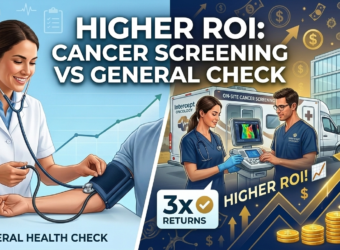
Why On-Site Cancer Screenings Offer a Higher ROI Than General Health Checks
Executive Summary
Standard annual employee checkups monitor general physiological baseline markers but leave critical vulnerabilities regarding early-stage cancer detection. Implementing oncologist-led on-site screenings yields direct financial ROI by preventing high-value critical insurance claims, reducing workplace absenteeism, and identifying pre-cancerous risk early.
For Human Resources directors, Chief People Officers, and enterprise leadership, evaluating corporate health benefits ultimately centers on a single question: Are our healthcare initiatives actively mitigating risk or merely fulfilling a compliance checkbox?
While standard annual employee health checks—typically featuring basic lipid panels, fasting blood sugar, and general vitals—are routine across corporate India, they leave a critical vulnerability unaddressed. Routine health checks are designed for broad physiological screening, not early-stage cancer detection.
Cancer represents one of the single largest drivers of catastrophic health claims, sudden employee absenteeism, and prolonged workplace disruption. Investing in specialized, oncologist-led early detection delivers a measurable return on investment (ROI) that generalized corporate health checks cannot match.
The Clinical and Economic Reality of Workplace Health
According to data from the Indian Council of Medical Research (ICMR) National Cancer Registry Programme, fewer than 1 in 3 common cancers in India are diagnosed at an early stage. The primary reason is not a lack of diagnostic technology, but a systemic delay in specialist contact. The traditional healthcare journey begins only after symptoms manifest—requiring GP visits, preliminary testing, and secondary referrals before an oncologist is ever consulted.
Comparing Diagnostic Routes
The Usual Route
Symptom Appears → GP Visit → Tests & Waiting → Specialist Referral → Late Diagnosis
With Intercept
While You Feel Well → On-Site Specialist Screening → 1-on-1 Consultation → Early Detection & Prevention
By bringing an oncologist directly to the workplace while employees feel well, organizations interrupt this delayed cycle.
1. Direct Financial ROI: Cost Avoidance in Medical Claims
The financial equation comparing standard wellness packages to specialized oncology screening is straightforward:
- Stage 1 vs. Stage 4 Cost Differential: Treatment for early-stage malignancies is significantly less invasive and far more cost-effective. Detecting a carcinoma at Stage 0 or Stage 1 reduces direct treatment expenses by up to 60% compared to advanced-stage care.
- Insurance Premium Stabilization: High-value critical illness claims drive up group health insurance premiums. Early-stage interventions prevent multi-lakh claim spikes, stabilizing annual corporate policy rates.
- Reduction of Indirect Loss: Beyond direct medical bills, late-stage diagnoses lead to extended disability leave, loss of institutional knowledge, and expensive recruitment replacement cycles.
2. Closing the Screening Gap: Targeted Clinical Precision
Standard executive health packages measure general markers like cholesterol or liver enzymes, but they omit targeted oncological evaluations. Specialized on-site cancer screenings address high-incidence, high-risk conditions directly:
| Evaluated Parameter | Standard Corporate Check | Intercept Specialist Screening |
|---|---|---|
| Lead Evaluator | General Physician / Technician | Consultant Oncologist |
| Oral Diagnostics | Basic dental check | Clinical oral cavity screening for pre-cancerous lesions |
| Breast Health | Visual inspection only | Radiation-free thermal imaging & clinical breast exam |
| Cervical Risk | Rarely covered | HPV awareness, vaccination pathways, & risk mapping |
| Result Delivery | Automated PDF email | One-on-one specialist consultation on-site |
Furthermore, multi-parameter screenings routinely uncover secondary asymptomatic conditions—such as severe anemia and severe Vitamin D deficiencies—that directly impair daily focus and employee productivity.
3. High Participation and Zero Workplace Disruption
Off-site health check vouchers yield low compliance. Employees rarely take personal leave to spend hours in a diagnostic clinic for preventive testing.
Bringing an oncologist-led mobile unit directly to your corporate facility eliminates logistical friction:
- 80%+ Utilization Rates: On-site deployment ensures maximum participation compared to hospital-bound voucher schemes.
- Immediate Specialist Clarity: Employees do not receive an obscure lab report requiring self-interpretation; every team member sits down with a specialist for immediate risk evaluation and personalized advice.
- Data Security & Anonymity: While individual medical consultations remain strictly confidential between employee and doctor, HR teams receive an aggregate, anonymized report mapping overall organizational risk factors.
Frequently Asked Questions (FAQs)
Why aren’t general employee health checks enough to detect cancer?
Routine corporate health checks evaluate general organ function through standard blood tests, blood pressure, and basic metabolic panels. They are not designed to identify pre-cancerous lesions, localized tumors, or early tissue changes. Specialized oncology screenings utilize risk-based evaluations, thermal imaging, and physical exams conducted directly by oncologists to catch early-stage risks.
How does an on-site cancer screening program impact group insurance costs?
Advanced-stage cancer treatments account for a significant portion of high-value corporate insurance claims, which drive up annual renewal premiums. By detecting health risks at Stage 0 or Stage 1, treatment costs drop dramatically, reducing catastrophic claim spikes and helping HR leaders stabilize group insurance costs over time.
Will personal health results be shared with company management?
No. Individual health screening results, clinical notes, and doctor consultations are strictly confidential between the employee and the specialist oncologist. Employers receive only high-level, anonymized cohort data to help HR design better corporate wellness policies without ever compromising personal medical privacy.
How long does an on-site employee screening take?
On-site programs are designed to minimize workplace disruption. A standard evaluation—including physical examinations, thermal imaging, and a private 1-on-1 oncologist consultation—takes approximately 15 to 20 minutes per employee.
Safeguard Your Human Capital with Intercept Oncology
Preventive care is an active risk-management strategy. Upgrade from general checkups to specialized, oncologist-led early detection to protect employee health and optimize organizational ROI.
Medical Disclaimer: The information provided in this article is for educational and corporate wellness planning purposes only and does not constitute formal individual medical advice. Clinical decisions and risk assessments should always be conducted in consultation with a qualified medical professional.